02 / Case Study · 2026
Efecto Placebo
Culture needs infrastructure too.
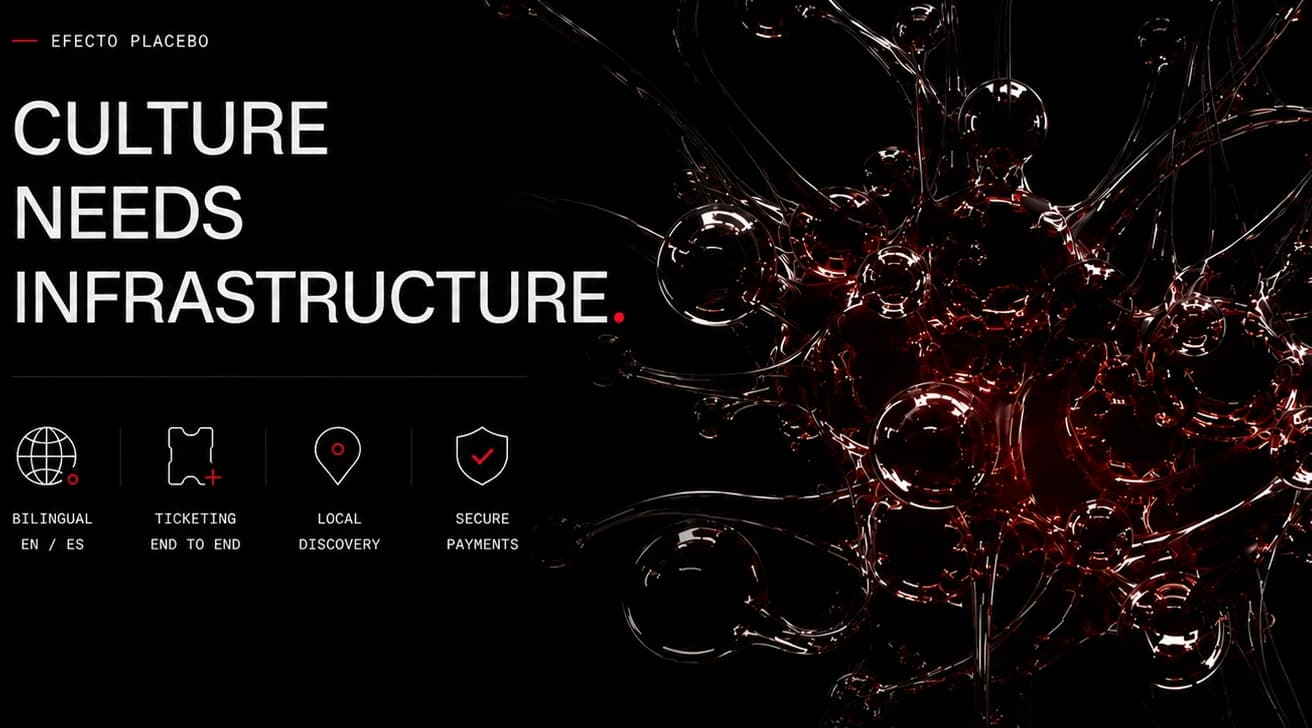
Efecto Placebo is a bilingual cultural events and ticketing platform I designed and engineered end-to-end—connecting identity, locale-aware event discovery, controlled ticket inventory, payments and event operations inside one product.
Loading live product
Creative Direction · Product Design · Full-Stack Engineering · Production
Next.js 16 · TypeScript · Supabase · PostgreSQL · Wompi · Vercel
Cultural Experience · Internationalisation · Ticketing · Operations
Live at efectoplacebo.live
02 / The challenge
A cultural platform cannot turn into a checkout product the moment someone wants a ticket.
Most event experiences split in two. The brand creates attention and desire; then an external ticketing platform takes over with a completely different interface, data model and customer relationship. Efecto Placebo was designed around the opposite premise.
The public experience, ticket inventory, checkout, customer account and operational workflows belong to the same product. The audience journey stays coherent from event discovery through fulfilment.
That meant solving two different problems simultaneously: an identity strong enough for a techno and cultural platform, and infrastructure predictable enough to manage real payments, finite capacity and admission at the door.
03 / Internationalisation
One system. Two languages. One continuous journey.
Spanish and English are treated as two views of the same live product—not as separate static websites. Locale-aware routes preserve the journey across event discovery, ticketing, customer accounts and operational content, while dynamic dates, availability states and calls to action are rendered in the selected language where localised content is available.
- 01Bilingual experience · ES / EN
- 02Locale-aware routing
- 03Dynamic event content
- 04Localised ticket journey
04 / Experience system
One identity. Three surfaces.
The product connects what the audience sees to the transactional and operational systems required to make the event actually run.
Discover
Events, moving artwork, collective identity and editorial content share one visual system. Event media behaves as part of the experience instead of becoming a catalogue of static thumbnails.
- Events
- Dynamic event media
- Collective
- Editorial / SEO
Convert
Ticket releases represent commercial strategy, finite capacity, admissions-per-unit and explicit promotions while keeping the customer-facing choice understandable.
- Ticket releases
- Capacity & reservations
- Promotions
- Checkout + Wompi
- Customer account
Operate
The same application supports the operational lifecycle required to configure events, manage fulfilment and control admission — without exposing those internal surfaces to the public experience.
- Event operations
- Orders + tickets
- Complimentary access
- Codes
- Staff access
- Admission
05 / Ticketing model
Ticketing is a state machine, not a buy button.
The audience sees a simple choice. Behind it, the product reconciles finite capacity, temporary reservations, release strategy, payment state and fulfilment.
A release has sellable inventory.
→Checkout temporarily holds capacity.
→The validated order moves to Wompi.
→Provider state reconciles into the order.
→Fulfilment creates customer access.
A failed payment initialisation gives capacity back immediately instead of depending only on a later expiry process.
Public product evidence
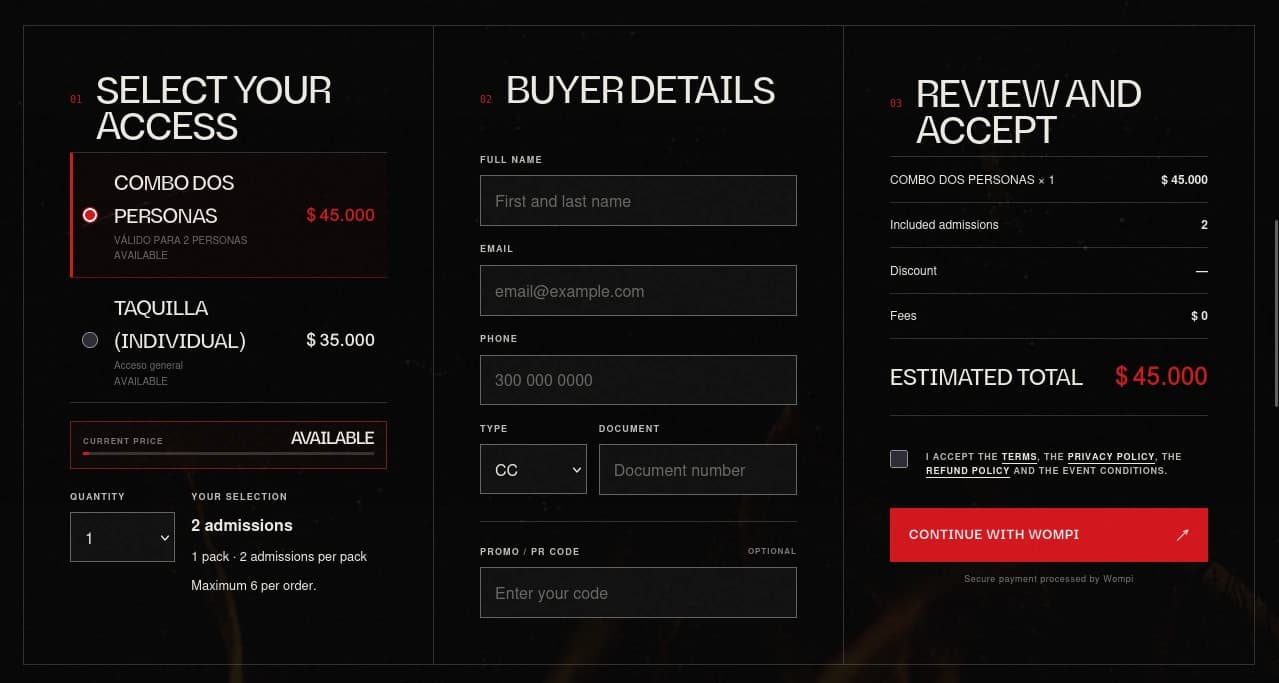
The transaction stays inside the experience.
This is the real customer-facing checkout: release selection, buyer data, promotion, review and Wompi handoff remain inside the same visual language as the cultural product.
Release strategy
Early Bird is explicit commercial intent rather than a price-based guess.
Product modelling
Individual and multi-person admissions can coexist inside the same capacity model.
Promotion
Promo codes are part of the checkout domain instead of an unrelated marketing layer.
Payment
The order is validated before the customer is handed to Wompi for payment.
Identity
The checkout remains unmistakably Efecto Placebo rather than becoming generic ecommerce.
06 / Visual direction
Atmosphere before interface.
The visual system treats the site less like an event catalogue and more like entering a space. Black creates the environment, grain and imagery carry physical texture, and red is held back for moments that need action.
07 / Engineering
The atmosphere sits on transactional infrastructure.
The interface is deliberately expressive. The infrastructure underneath it has to be deliberately predictable: capacity, payment state and fulfilment cannot depend on visual improvisation.
Inventory integrity
Event and ticket availability are calculated against controlled capacity, including sold and temporarily reserved quantities. Reservation cleanup prevents abandoned checkouts from quietly consuming inventory.
Payment reliability
Checkout validates the purchase before payment creation, protects repeated requests through idempotent behaviour and persists Wompi payment events as part of the order lifecycle. Failed payment initialisation releases inventory immediately.
Promotion & release logic
Ticket releases can express commercial intent — including explicit Early Bird promotions — while preserving capacity and sequencing rules. Savings per ticket, pack economics and order-level discounts remain distinct concepts.
Operational control
Role-protected internal tooling supports event configuration, fulfilment, complimentary access and admission workflows. Significant mutations can be audited without exposing operational interfaces publicly.
Selected product decisions
The model matters as much as the interface.
Keep ticketing inside the Efecto Placebo product instead of handing the audience to a visually unrelated marketplace.
The transaction feels like a continuation of the event experience rather than an interruption.
Model admission capacity, units sold and people admitted as related but distinct concepts.
Individual admissions and multi-person ticket products can coexist without corrupting venue capacity.
Represent promotional intent explicitly instead of inferring an Early Bird offer from price alone.
Commercial meaning stays consistent across the customer experience and the underlying product model.
Treat narrow-screen reliability as a system requirement, including dense operational workflows used in real event conditions.
Responsive behaviour is an application-level concern rather than a polish pass on the public landing page.
Full-stack system flow
From announcement to admission.
Internal operational interfaces stay private; the case study documents their role in the system without exposing back-office screens or sensitive workflows.
Verified production evidence
Built, tested and running in production.
The strongest evidence is behavioural: what the platform actually has to guarantee when real inventory, money and audience access move through the system.
A successful payment resolves into an order and usable ticket rather than ending at the payment-provider redirect.
Sellable quantity incorporates sold and temporarily reserved units instead of treating capacity as static content.
States such as Early Bird live in the product model rather than being inferred from price alone.
Failed payment initialisation releases reserved inventory rather than leaving unnecessary holds behind.
Orders and tickets remain accessible through customer-facing account and order surfaces.
Role-protected workflows support configuration, fulfilment and admission while remaining private from the public experience.
Public and dense application surfaces are treated as narrow-screen requirements, not desktop-only tools.
The application is continuously built and deployed at efectoplacebo.live.
08 / Result
One product, from announcement to admission.
Efecto Placebo started with a cultural proposition, but building the experience properly meant treating ticketing and operations as part of the design problem. The resulting platform connects visual identity, event media, discovery, ticket releases, promotions, finite inventory, payments, customer access and admission without fragmenting them across unrelated products.
The visible website is only the front of the system.
A distinctive public identity built for events rather than ecommerce.
Ticket inventory, promotions, reservation state and Wompi payments.
The systems required to configure, sell, fulfil and admit the audience.